AI in Practice: It’s Not About the Tech, It’s About a Total Business Revolution
We’re living in the age of artificial intelligence. Every day, headlines buzz with news of smarter chatbots, mind-blowing image generators, and algorithms that can write code. It’s easy to get lost in the hype and see AI as a collection of shiny new toys. But if you’re only focused on the latest generative model, you’re missing the real story. The true AI revolution isn’t happening in a chat window; it’s happening deep inside the world’s most innovative organizations.
A recent AI in Practice report from the Financial Times cuts through the noise with a powerful message: to truly harness the power of AI, a “complete rethink of business models” is required. This isn’t about simply plugging a new piece of software into your existing workflow. It’s about fundamentally re-imagining how your business operates, creates value, and competes.
This is the shift from “doing AI” to “being AI-native.” It’s a transformation that’s already creating new winners and losers across every sector, from scientific research and professional services to the very nature of national defense. Let’s dive into what this revolution looks like in practice and what it means for you, whether you’re a developer, an entrepreneur, or a business leader.
The AI Imperative: Why a “Complete Rethink” is Non-Negotiable
For years, businesses have used software to optimize existing processes. We built software to do accounting faster, manage customer relationships more efficiently, and streamline supply chains. This was automation 1.0. Artificial intelligence, however, presents a different kind of opportunity. It’s not just about doing the same things faster; it’s about doing entirely new things.
Think of the transition from the horse-drawn carriage to the automobile. The goal of the carriage owner was to find a stronger, faster horse. The goal of the automaker was to completely change the concepts of distance, travel, and personal freedom. Simply trying to build a “robot horse” would have missed the point entirely.
Many companies today are still in the “robot horse” mindset. They implement an AI-powered chatbot to answer customer queries but keep the same old support structure. They use a machine learning model to forecast sales but don’t change their inventory or marketing strategies. These are incremental improvements, but they fall short of the transformative potential.
A true AI-native business model asks different questions:
- Instead of “How can AI reduce our customer support costs?”, it asks, “How can AI create a personalized, proactive customer experience that eliminates the need for most support tickets in the first place?”
- Instead of “How can we use machine learning to predict machine failure?”, it asks, “How can we build a ‘maintenance-as-a-service’ model where we sell uptime and reliability, not just machines?”
This is the “complete rethink” the FT report highlights. It involves changing not just your technology stack but your value proposition, your revenue models, and your corporate culture. For startups, this is a massive opportunity to build AI-native companies from the ground up, unburdened by legacy systems and thinking. For established players, it’s a critical, do-or-die challenge that requires bold leadership and a commitment to genuine innovation.
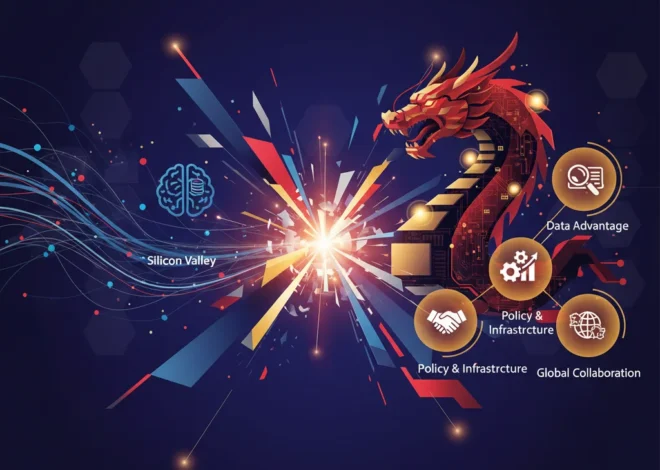
The AI Cold War: How China is Quietly Winning the Open-Source Revolution
The Automated Lab: AI as the Ultimate Research Assistant
Nowhere is this transformative potential more apparent than in the world of scientific research and development. The report notes that “robots promise to take the grunt work out of lab experiments,” and this is a profound understatement. For centuries, scientific discovery has been bottlenecked by the slow, meticulous, and often repetitive nature of lab work.
Imagine a team of biochemists trying to find a new drug. They might have to manually test thousands of chemical compounds, a process that can take years. Today, AI-powered automation is changing the game. High-throughput screening robots, guided by machine learning algorithms, can perform millions of experiments in a matter of days. The AI doesn’t just run the tests; it learns from the results in real-time, intelligently prioritizing the most promising compounds for the next round of experiments.
This creates a powerful feedback loop:
- Automated Experimentation: Robots physically perform tests (mixing liquids, analyzing cells, etc.).
- Data Capture: Sensors and cameras collect massive amounts of data from each experiment.
- ML Analysis: Machine learning models analyze this data, identifying patterns and correlations invisible to the human eye.
- Hypothesis Generation: The AI suggests new hypotheses and designs the next set of experiments to test them.
This isn’t science fiction. Companies like Recursion and Insitro are using this approach to reinvent drug discovery. The impact extends beyond medicine to materials science, agriculture, and renewable energy. By taking the “grunt work” out of R&D (source), we are freeing up our brightest scientific minds to focus on what they do best: creative problem-solving, strategic thinking, and asking the big questions that lead to breakthrough discoveries.
AI on the Front Lines: From the Boardroom to the Battlefield
As AI matures, its adoption is creating clear competitive divides in established industries. The FT report specifically calls out professional services and the military as two arenas where AI is already a game-changer.
Professional Services: The Hunt for a Competitive Edge
Firms in law, accounting, and consulting trade on expertise and efficiency. For decades, their business model relied on armies of junior associates billing hours to perform tedious tasks like document review, due diligence, and data entry. AI is blowing this model apart.
AI-powered software can now analyze thousands of legal contracts in minutes, flagging risks and inconsistencies that a human might miss. In finance, machine learning algorithms can audit entire sets of financial transactions, not just a small sample, identifying fraud and anomalies with superhuman accuracy. This quest for a competitive edge is driving rapid adoption.
Let’s look at the practical differences in a common task like legal discovery:
| Task | Traditional Approach (Before AI) | AI-Powered Approach |
|---|---|---|
| Document Review | Teams of paralegals manually read millions of pages to find relevant documents. Extremely slow, expensive, and prone to error. | Natural Language Processing (NLP) models scan all documents, identifying relevant concepts, entities, and sentiment in a fraction of the time. |
| Privilege Identification | Junior lawyers manually flag documents containing sensitive attorney-client communications. | AI classifiers are trained to automatically identify and redact privileged information with high accuracy. |
| Case Strategy | Relies on the experience and intuition of senior partners. | Predictive analytics models analyze past case law and judicial decisions to forecast potential outcomes and suggest optimal legal strategies. |
The firms that embrace this shift can offer better, faster, and more cost-effective services. Those that don’t risk being outmaneuvered and becoming obsolete.
The Cryptographers Who Lost Their Keys: A Modern Fable for Tech Startups
Reshaping the Battlefield: The Military’s AI Ambition
Perhaps the most high-stakes application of AI is in national defense. The report mentions that “military chiefs aim to reshape the battlefield,” a goal that encompasses everything from logistics to combat.
Modern warfare is a battle of information. The side that can process data faster and make better decisions more quickly has a decisive advantage. AI and machine learning are central to this. They are being used to:
- Analyze Intelligence: Sift through immense volumes of satellite imagery, drone footage, and signals intelligence to identify threats and patterns.
- Power Autonomous Systems: Operate drones and other unmanned vehicles for surveillance, reconnaissance, and logistics.
- Enhance Cybersecurity: Proactively detect and respond to cyberattacks on critical military networks in real-time.
- Optimize Logistics: Manage complex global supply chains, predict maintenance needs for vehicles and aircraft, and ensure resources are in the right place at the right time.
This technological arms race raises profound ethical and security questions, particularly around lethal autonomous weapons systems (LAWS). Ensuring that AI systems are reliable, secure from hacking, and operate within the bounds of international law is a paramount challenge. The role of cybersecurity in this domain cannot be overstated; an AI system compromised by an adversary could be catastrophic.
The Developer & Entrepreneur’s Playbook
So, what does this all mean for the builders and innovators? The opportunities are immense, but they require a strategic focus.
For Developers: The demand is shifting from generalist programmers to those with specialized AI skills. Mastering Python and key machine learning frameworks like TensorFlow and PyTorch is essential. However, the real value lies in understanding the entire AI pipeline. This includes data engineering (how to build robust data sources), MLOps (how to deploy, monitor, and maintain models in production), and cloud architecture (leveraging platforms like AWS, Azure, and GCP for scalable AI). Expertise in a specific domain, like NLP for legal tech or computer vision for manufacturing, will make you invaluable.
For Entrepreneurs & Startups: The low-hanging fruit of building simple AI wrappers is gone. The next wave of successful AI startups will be those that solve deep, industry-specific problems. Instead of building another generic chatbot, consider a SaaS platform that automates a specific, painful workflow in a niche industry like regulatory compliance or agricultural management. The key is to build “systems of intelligence” that not only automate tasks but also learn from data to provide unique insights that become a core part of the customer’s business model. The future is in building defensible, data-driven businesses, not just clever software.
The Ultimate Debug: How AI and Startups Are Taking on Human Aging
Conclusion: The Practice is the Revolution
The age of theoretical AI is over. We are now firmly in the era of AI in practice, where the technology is not just a subject of academic papers but a driving force of economic and societal change. As the FT report makes clear, success is not guaranteed by simply buying an AI tool. It requires a courageous willingness to challenge long-held assumptions and fundamentally rethink the very nature of your business.
From the lab to the law firm to the battlefield, artificial intelligence is creating a new competitive landscape. It’s a landscape that rewards agility, data fluency, and strategic vision. The revolution isn’t coming—it’s already here. The only question is whether you’re ready to lead it.