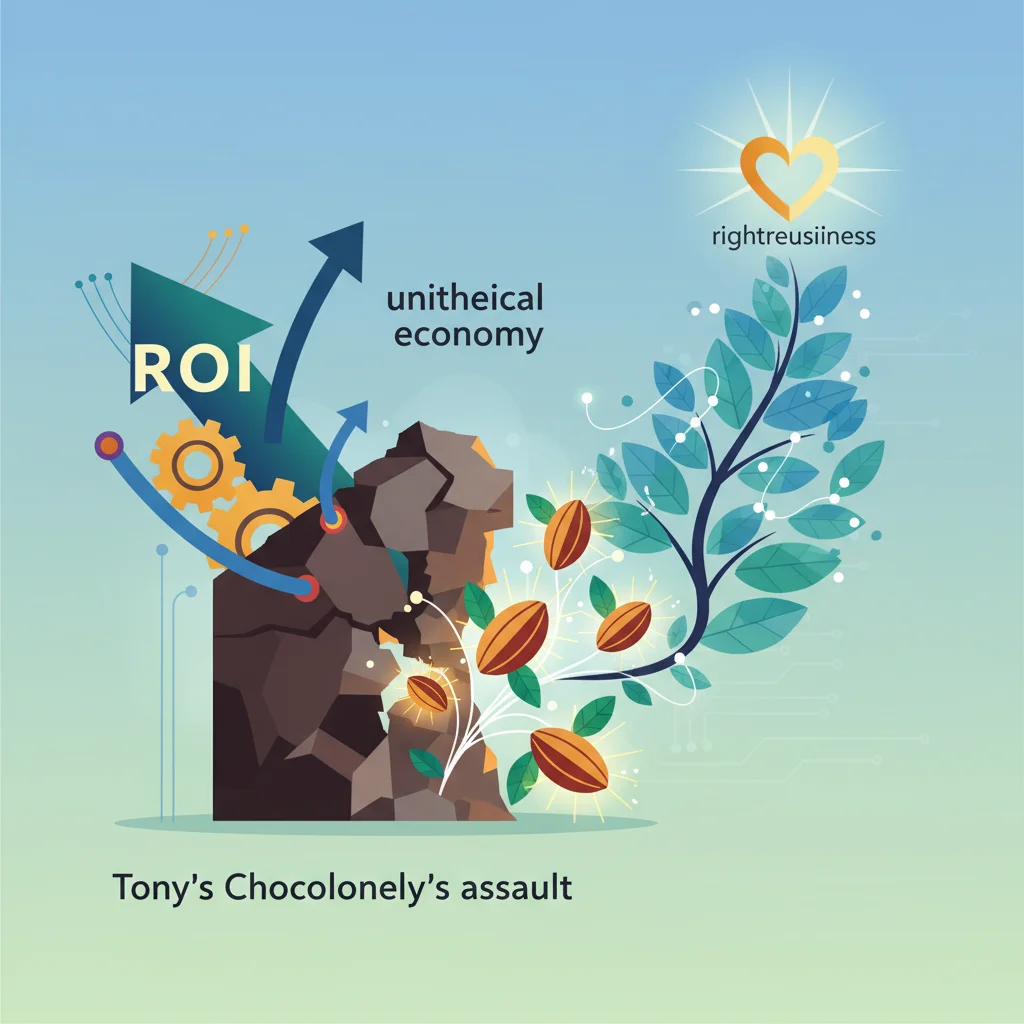
The ROI of Righteousness: Deconstructing Tony’s Chocolonely’s Assault on an Unethical Economy
In the world of finance and investing, we often focus on quarterly earnings, market fluctuations, and disruptive technologies. But what if the most profound disruption isn’t a new fintech app, but a new business model—one that forces us to confront the dark economic realities hidden within our everyday luxuries? Consider your favorite chocolate bar. It’s a small indulgence, a comfort food. Yet, for millions, the journey from bean to bar is paved with exploitation, a grim reality that the global cocoa industry has struggled to address for decades.
Enter Tony’s Chocolonely, a Dutch confectioner that has transformed from a quirky activist brand into a formidable business school case study. Their mission is audacious: to make 100% slave-free the norm in the chocolate industry. This isn’t just a feel-good marketing slogan; it’s a radical reimagining of supply chain economics and corporate responsibility. For investors, business leaders, and finance professionals, Tony’s story is more than just about chocolate. It’s a masterclass in building brand equity, mitigating long-term supply chain risk, and tapping into the powerful economic force of conscious consumerism. It challenges us to ask a fundamental question: can a business be a force for profound social change and still deliver exceptional financial results?
The Bitter Economics of the Cocoa Supply Chain
To understand the genius of Tony’s model, one must first grasp the systemic brokenness of the traditional cocoa economy. The global chocolate industry is a behemoth, worth over $130 billion. Yet, the farmers at the very beginning of this value chain, primarily in West African nations like Ghana and Côte d’Ivoire, live in extreme poverty. The price they receive for their cocoa beans is determined by global commodity markets, leaving them with razor-thin margins that are insufficient to earn a living income.
This dire financial pressure creates a perverse incentive structure. To survive, farmers resort to the cheapest labor available, leading to an estimated 1.56 million children working in cocoa production in Ghana and Côte d’Ivoire alone. The supply chain is notoriously opaque; beans from thousands of small farms are mixed, making it nearly impossible for large corporations to trace their raw materials back to a specific source and verify the labor conditions. This is a classic market failure, a flaw in the basic economics of the system that has persisted for generations.
The Nuclear Paradox: Why the UK's Energy Ambitions Are a High-Stakes Gamble for Investors
A New Recipe: Tony’s 5 Sourcing Principles
Tony’s Chocolonely rejected this status quo. Instead of working around the broken system, they built a new one from the ground up, based on five clear, actionable, and—most importantly—transparent principles. These principles are not just a moral framework; they represent a complete overhaul of supply chain finance and logistics.
Here’s a breakdown of how their model directly confronts the failures of the traditional system:
| Tony’s Sourcing Principle | How It Disrupts Traditional Cocoa Economics |
|---|---|
| 1. Traceable Cocoa Beans | Instead of buying from anonymous aggregators, Tony’s works directly with specific farmer cooperatives. This direct relationship is the foundation of accountability. From a fintech perspective, this is where technologies like blockchain could offer an industry-wide solution for immutable, transparent ledgers. |
| 2. Paying a Higher Price | Tony’s pays a significant premium on top of the farmgate price, an amount calculated to ensure farmers earn a living income. This directly injects capital where it’s most needed, stabilizing the micro-economy of the farming community and reducing the economic pressure for child labor. |
| 3. Strong Farmers | The company invests in professionalizing farmer cooperatives, empowering them to operate as businesses. This improves efficiency, yield, and their long-term financial viability, making them more resilient partners. |
| 4. The Long Term | Tony’s guarantees to buy from their partner cooperatives for at least five years. This long-term commitment provides financial security, enabling farmers and banking institutions to invest in farm improvements with confidence, knowing a buyer is secured. |
| 5. Improved Productivity and Quality | Through training and investment, Tony’s helps farmers improve their agricultural practices. This not only increases their yields (and income) but also ensures a higher-quality product for Tony’s, creating a mutually beneficial financial loop. |
This five-pronged approach is a powerful example of how targeted financial and structural interventions can rewrite the rules of an entire industry. It transforms the supply chain from a purely extractive model to a collaborative one.
The Open Chain: A New Paradigm for Financial Technology and Transparency
The most radical part of Tony’s strategy is their “Open Chain” initiative. It’s an open-source platform where other chocolate makers can access Tony’s network and methods to create their own fully traceable, ethical supply chains. This moves beyond corporate social responsibility into the realm of systemic change. By sharing their blueprint, they aim to create a tide that lifts all boats, making ethical sourcing the default, not the exception.
This is where the potential for financial technology becomes truly exciting. Imagine an Open Chain platform powered by blockchain, providing an incorruptible, real-time record of every transaction from the cooperative to the consumer. Such a system could revolutionize supply chain finance, enabling banks and investors to fund ethical producers with greater confidence, potentially at lower rates due to reduced risk. It would provide consumers with absolute certainty about their purchase and give regulators an unprecedented view into an industry that has long operated in the shadows.
Unlocking Britain's Growth: Can Banks and Fintech Solve the SME Credit Crisis?
The Growth Dilemma: Scaling Impact Without Selling Out
As Tony’s grows, it faces the classic entrepreneur’s dilemma. As detailed in the Financial Times case study, the company is at a crossroads. To achieve its mission of making the entire industry slave-free, it needs to scale its impact. This presents two challenging paths:
- Partner with “Big Choco”: By having a major corporation adopt their Open Chain principles, Tony’s could change millions of lives overnight. However, this risks brand dilution and accusations of “selling out” from their loyal customer base. A partnership could be seen as an endorsement of a company they have long criticized.
- Go It Alone: Continue their organic growth, maintaining absolute control over their brand and mission. This path is “purer,” but significantly slower. It might take decades to achieve the industry-wide change they seek, during which time millions will continue to be exploited.
From an investor’s standpoint, this is a fascinating risk-reward calculation. A partnership could lead to a massive, short-term revenue spike and market validation. However, the long-term value of Tony’s is intrinsically tied to its brand authenticity. Damaging that could be a catastrophic, irreversible error. This strategic tightrope walk is a critical lesson for any business leader trying to balance purpose with profit.
Lessons for the Modern Investor and the Future Economy
Tony’s Chocolonely’s journey offers profound insights for anyone involved in finance, business, or the broader economy. It demonstrates that ethical considerations are no longer a “soft” topic but a core component of long-term financial strategy.
Firstly, it proves that transparency is a powerful asset. In an age of information, consumers and investors are increasingly demanding to know the story behind their products and portfolios. Companies that embrace radical transparency can build unshakable brand loyalty and command a premium price.
Secondly, it reframes risk management. A supply chain built on exploitation is inherently unstable. It is vulnerable to journalistic exposés, consumer boycotts, and regulatory crackdowns. By investing in an ethical and stable supply chain, Tony’s has effectively de-risked its most critical business input, a move that any shrewd investor should applaud.
Finally, Tony’s serves as a living blueprint for the future of ESG investing. It shows that “Social” and “Governance” are not just checkboxes on a report but are drivers of innovation and value creation. The model provides a clear, measurable way to link financial investment to positive social outcomes, moving beyond vague promises to deliver tangible impact.
The story of Tony’s Chocolonely is far from over. The dilemmas they face are real and the stakes are incredibly high. But their journey has already provided an invaluable lesson for the business world: fixing a broken system isn’t just a moral imperative, it’s one of the greatest business opportunities of our time. By rewriting the economics of a single industry, they are challenging all of us to think bigger about the role of capital in building a more equitable and sustainable world.

Related Posts

Beyond the Balance Sheet: Why a Community Warm Space is a Critical Indicator for the Modern Investor

The Billion-Dollar Footprint: Why Niche Markets Are the Next Frontier in Finance and Investing
