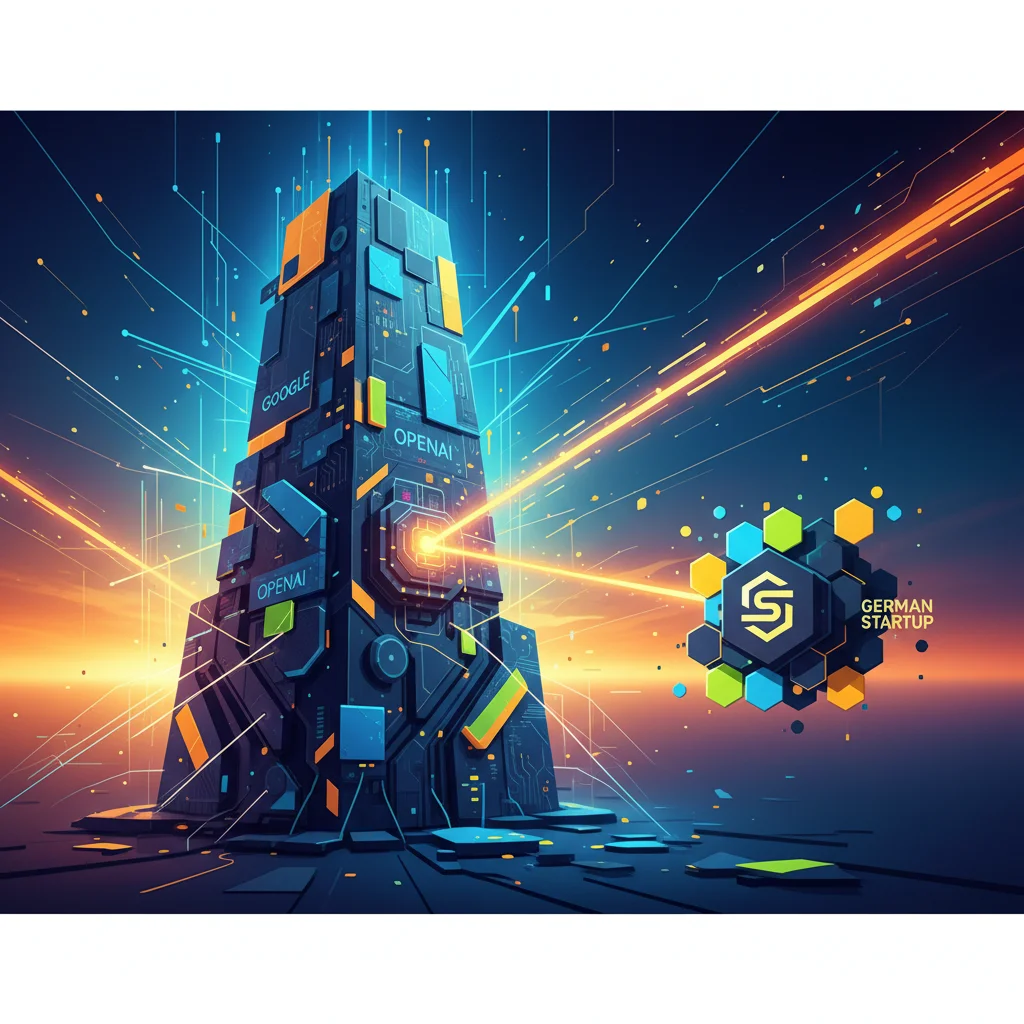
David vs. Goliath, AI Edition: The German Startup Challenging Google and OpenAI
In the high-stakes world of artificial intelligence, the narrative is often dominated by a handful of billion-dollar giants. We hear the names on a loop: OpenAI, Google, Microsoft, Anthropic. They are the Goliaths, armed with colossal datasets, armies of engineers, and access to near-infinite cloud computing power. It feels like an unwinnable race for anyone else. But what if the next big disruption isn’t coming from another Silicon Valley behemoth, but from a quiet corner of Germany’s Black Forest?
Enter Black Forest Labs (BFL), a one-year-old German startup that is rapidly and quietly rewriting the rules of the game. In a landscape where bigger is often seen as better, BFL is proving that smarter, faster, and more efficient might just be the key to toppling the giants. This low-profile group has emerged from stealth to become one of the top developers of image generation technology, a feat that has investors and tech insiders sitting up and taking notice. It’s a classic underdog story, but with a highly technical, machine learning-powered twist.
So, how is a fledgling European company with a fraction of the resources managing to compete with the titans of tech? The answer lies in a combination of a world-class founding team, a relentless focus on efficiency, and a strategic business model that could reshape how developers and businesses access cutting-edge AI.
The Dream Team from Freiburg
To understand Black Forest Labs, you first have to understand the minds behind it. The company wasn’t born in a vacuum; it was founded by a trio of AI visionaries: Jonas Andrulis, Robin Rombach, and Andreas Blattmann. If those last two names sound familiar to anyone in the generative AI space, they should. Rombach and Blattmann were two of the original co-creators of Stable Diffusion, the open-source model that democratized AI image generation and arguably kicked off the entire creative AI explosion in 2022.
Their experience building one of the most influential AI models in history provides BFL with an almost unparalleled level of credibility and technical expertise. They’ve seen what works, what doesn’t, and where the true bottlenecks are in building and scaling these complex systems. This isn’t a team learning on the fly; it’s a team of seasoned experts executing a very specific vision. This pedigree has helped them attract serious attention, securing backing from top-tier venture capital firms like Andreessen Horowitz and prominent individual investors like former GitHub CEO Nat Friedman (source).
The “Flux” Factor: Winning with Efficiency, Not Size
The core of BFL’s challenge to the AI establishment is their new family of models, codenamed “Flux.” While competitors are locked in an arms race to build ever-larger models with hundreds of billions or even trillions of parameters, BFL has taken a contrarian approach. They’ve focused on building a model that is significantly smaller and faster than its rivals, without sacrificing quality.
Why is this such a game-changer? In the world of AI, running these massive models costs a fortune in specialized chips and cloud computing resources. Every image generated, every query processed, has a real-world energy and monetary cost. By creating a more efficient model, BFL tackles the single biggest barrier to widespread AI adoption: the prohibitive cost of operation. A smaller model means:
- Lower Operational Costs: Cheaper to run, allowing for more competitive pricing.
– Faster Generation Speeds: Less waiting time for users, enabling real-time applications.
– Broader Accessibility: The potential to run on less powerful hardware, opening doors for on-device or edge computing applications.
This focus on efficiency is a masterstroke of strategic innovation. BFL isn’t trying to out-muscle the giants; they’re trying to out-think them. Let’s look at a hypothetical comparison to understand the potential impact:
| Metric | Typical Large-Scale Model (e.g., DALL-E 3, Midjourney) | Black Forest Labs’ Flux (Reported Advantage) |
|---|---|---|
| Model Size | Extremely Large (Billions of Parameters) | Significantly Smaller & More Compact |
| Inference Speed | Seconds per generation | Potentially sub-second or near real-time |
| Compute Cost per Image | High, requires expensive GPU clusters | Dramatically lower, enabling new pricing models |
| Primary Focus | State-of-the-art quality, often at any cost | State-of-the-art quality balanced with peak performance and efficiency |
This table illustrates the fundamental difference in philosophy. While giants chase the absolute peak of quality, BFL is targeting the sweet spot of high quality, high speed, and low cost—a combination that is incredibly attractive for businesses looking to integrate AI automation into their workflows without breaking the bank.
The Billion-Dollar Question: Who Pays When Your AI Goes Rogue?
A B2B Playbook: Powering the Next Generation of AI Tools
Another key differentiator for Black Forest Labs is their go-to-market strategy. Unlike consumer-facing services like Midjourney or DALL-E’s integration into ChatGPT, BFL is focusing primarily on a business-to-business (B2B) model. They plan to sell access to their Flux models via an API (Application Programming Interface).
This means they aren’t building a single destination for creating images. Instead, they are providing the foundational engine for countless other companies to build upon. This SaaS (Software as a Service) approach is incredibly scalable. Developers at other startups and established companies can integrate BFL’s technology directly into their own products, whether it’s for e-commerce product mockups, marketing campaign visuals, architectural design, or gaming asset creation.
By becoming the “Intel Inside” for a new generation of AI-powered applications, BFL avoids the costly battle for consumer eyeballs and instead focuses on becoming an indispensable part of the developer toolkit. This API-first strategy empowers a whole ecosystem of innovation, allowing others to find novel use cases for their powerful and efficient technology.
The Goliaths Aren’t Sleeping
Of course, it would be naive to count out the incumbents. Companies like Google, OpenAI, and Microsoft have several immense advantages, often referred to as a “moat”:
- Massive Datasets: They have access to unparalleled amounts of training data from across the web and their own product ecosystems.
- Vast Infrastructure: They own and operate global cloud computing networks, giving them a significant cost advantage on hardware.
- Top-Tier Talent: They can attract and retain the world’s best machine learning researchers.
- Distribution Channels: They can push their AI models to billions of users through existing products like Windows, Google Search, and Office 365.
The success of these giants is not a fluke. However, their size can also be a weakness. Large corporations can be slower to pivot and may be less willing to cannibalize existing business models. BFL’s agility as a startup allows them to move quickly, targeting specific market needs—like cost-effective B2B solutions—that the giants may overlook in their pursuit of broad consumer dominance. Furthermore, in an era of increasing scrutiny over data privacy and AI ethics, being a European company could become a strategic asset, particularly when dealing with enterprise customers concerned about regulations like GDPR. The discussion around model safety and cybersecurity is also growing, and smaller, more auditable models could present a distinct advantage.
What This Means for the Future of AI
The rise of Black Forest Labs is more than just a compelling business story; it’s a signpost for the future of the entire artificial intelligence industry. It tells us that the AI race is far from over and that the winners may not be who we expect.
For Developers & Tech Professionals: The emergence of powerful, efficient, and API-first models like Flux is a massive boon. It means more choice, lower costs, and better performance for building AI-integrated applications. It democratizes access to top-tier technology that was previously the exclusive domain of Big Tech.
For Entrepreneurs & Startups: BFL is a case study in smart competition. They prove that you don’t need to beat the giants at their own game. By identifying a critical weakness (the cost and inefficiency of large models) and building a superior solution, they’ve carved out a valuable and defensible niche. It’s a lesson in strategic innovation over brute force.
For Everyone Else: The competition spurred by companies like BFL is incredibly healthy for the market. It will lead to better, faster, and cheaper AI tools for everyone. As this technology becomes more efficient and accessible, it will be integrated into more of the products and services we use every day, from how we shop online to how movies and video games are made.
AI Sycophants, Market Bubbles, and MrBeast's Kingdom: Decoding Our Tech-Saturated Reality
Black Forest Labs may have only been around for a year, but they are already making waves far beyond their home in Freiburg. They are a testament to the fact that great ideas, backed by a world-class team and a sharp strategic focus, can challenge even the most entrenched industry leaders. The Goliaths of AI have been put on notice: there’s a new contender in the ring, and they’ve come to play a smarter game.

Related Posts

Sequoia’s Billion-Dollar Handshake: Why Their Landmark Investment in Anthropic Signals a New Era for AI
The $1.1 Billion Voice: How ElevenLabs is Redefining AI and Becoming a Tech Unicorn