Cosmic Rays vs. Code: Why 6,000 Airbus Jets Need a Software Patch and What It Teaches the Tech World
We board a plane, settle into our seats, and place an immense amount of trust in the millions of lines of code humming away in the background. We trust the software that controls the engines, the navigation that guides the pilots, and the systems that keep the cabin pressurized. It’s a silent, digital contract. But what happens when the threat to that code isn’t a hacker or a bug, but something far more fundamental—a particle from deep space?
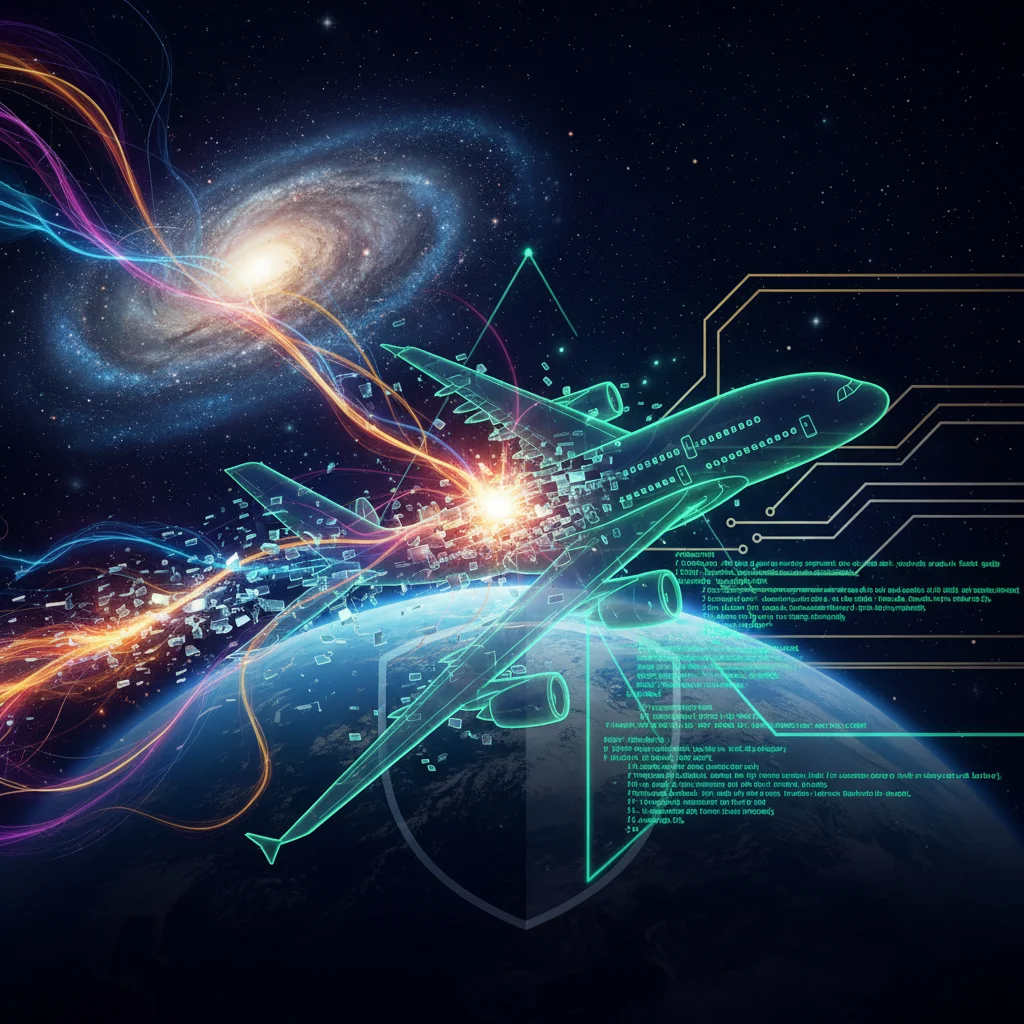
Recently, a startling headline emerged: Airbus is issuing a mandatory software fix for its A320neo family of jets, potentially affecting up to 6,000 aircraft. The reason? To mitigate potential problems caused by solar radiation. This isn’t science fiction. It’s a real-world, high-stakes scenario that serves as a powerful parable for everyone in the technology space—from developers and cybersecurity experts to startup founders and AI engineers. This story goes far beyond aviation; it’s a critical lesson in building resilient systems in an inherently chaotic universe.
The Ghost in the Machine: When a Sunbeam Can Flip a Bit
The issue at hand isn’t a typical software bug written by a tired programmer. Instead, it’s a vulnerability to a phenomenon known as a Single Event Upset (SEU). Imagine a high-energy particle, a cosmic ray flung from the sun or a distant supernova, hurtling through space. When an aircraft flies at high altitudes, the atmosphere provides less protection, and these particles can strike a microchip—like the one in a plane’s Flight Augmentation Computer (FAC).
This impact can be just energetic enough to flip a single bit of memory from a 0 to a 1, or vice versa. It’s a “bit flip.” In most of our daily computing, this might result in a single pixel on your screen being the wrong color for a millisecond—you’d never even notice. But in a mission-critical system, a single bit flip in the wrong place at the wrong time could have serious consequences. The European Union Aviation Safety Agency (EASA) issued a directive noting that this could, in a worst-case scenario, affect the aircraft’s flight control laws, a risk that prompted this proactive software update (source).
This isn’t just an aerospace problem. Companies like Google have documented that bit flips from cosmic rays are a significant source of errors in their vast data centers on the ground (source). The digital world we’ve built, from the **cloud** to our local devices, is constantly being bombarded by this invisible rain. Airbus’s challenge is simply a more acute, higher-stakes version of a problem that affects all modern technology.
Not Your Average Sprint Cycle: The World of Mission-Critical Software
For developers working on a new **SaaS** application, the process involves sprints, continuous integration, and rapid deployment. A bug can be patched and pushed to production in hours. In the world of aerospace, the **programming** and validation process is fundamentally different. The stakes are infinitely higher, and the environment is unforgiving.
Software in this domain is built on principles of extreme redundancy and fault tolerance. You don’t just have one computer; you have multiple, often three, running the same calculations. If one computer’s result differs from the other two (perhaps due to an SEU), the system can identify the outlier and discard its result. This is the bedrock of safety-critical **innovation**.
To illustrate the difference, here’s a look at how developing a typical web app compares to creating flight control software:
| Aspect | Conventional Software (e.g., SaaS App) | Aerospace Software (e.g., Flight Control) |
|---|---|---|
| Primary Goal | Features, user experience, speed to market | Safety, reliability, predictability |
| Development Model | Agile, Scrum, CI/CD | Waterfall, V-Model, strict formal verification |
| Tolerance for Failure | Moderate (e.g., “fail fast,” patch quickly) | Extremely low (must be fault-tolerant by design) |
| Key Challenge | Scaling, competition, user retention | Hardware failures, environmental factors, certification |
| Testing Approach | Unit tests, integration tests, A/B testing | 100% code coverage, hardware-in-the-loop simulation, formal methods |
This Airbus update is a perfect example of the aerospace philosophy. The fix isn’t a reaction to a crash, but a proactive measure to harden the system against a known, low-probability risk. It’s a testament to the power of **software** to solve a hardware-level environmental problem.
The Billion-Dollar Question: Who Pays When Your AI Goes Rogue?
Think about an AI-powered autonomous vehicle. What happens if a cosmic ray flips a bit in the memory that stores a crucial parameter of its perception model? It might misclassify a pedestrian as a shadow. Consider an AI in a hospital interpreting an MRI scan. A bit flip could subtly alter the data, leading to a misdiagnosis. These aren’t just software bugs; they are insidious hardware-level corruptions that most of our current systems aren’t designed to detect. The challenge for the next decade of innovation is to build AI and automated systems that are not just smart, but fundamentally robust against the chaotic nature of reality itself. We need to move from “fail-safe” to “fail-operational.”
The Ripple Effect: From the Cockpit to the Cloud
It’s tempting to dismiss this as a niche problem for billion-dollar jets. That would be a mistake. The principles at play here have direct implications for anyone building or relying on technology today, especially in the realms of **cloud** computing, **cybersecurity**, and **AI**.
1. The Cloud is Not a Cloud, It’s Someone Else’s (Susceptible) Computer
The abstract nature of cloud computing makes it easy to forget that our code is running on physical servers in a data center somewhere. These servers are just as susceptible to SEUs as an airplane’s computer, if not more so due to the sheer density of processors. While hyperscalers use Error-Correcting Code (ECC) memory, it’s not foolproof. For **startups** building their entire infrastructure on the cloud, this means architecting for resilience is non-negotiable. Don’t assume the platform will handle everything. Employing multi-region redundancy and designing stateless services are no longer just for scaling—they are fundamental to surviving random, unpredictable hardware failures.
2. A New Frontier in Cybersecurity
The cybersecurity implications of bit flips are subtle but terrifying. Imagine a particle striking a memory location that holds a boolean variable for `is_user_authenticated`. A flip from `false` (0) to `true` (1) could theoretically grant unauthorized access. Or it could corrupt a cryptographic key in memory, causing a secure connection to fail. While the probability is low, state-sponsored actors with immense resources could potentially explore ways to induce these faults. This blurs the line between a hardware fault and a security breach, forcing us to expand our definition of a threat vector.
Google's Ad Empire on Trial: Why a US Judge Is Wary of a Breakup
3. The Achilles’ Heel of Automation and AI
The more we delegate critical decisions to automated systems, the more we need to worry about their integrity. The output of a **machine learning** model is the result of billions of calculations. A single bit flip during that process could cascade into a wildly incorrect or unpredictable output. This is a huge challenge for AI safety. We need to develop **AI** systems that are not only accurate but also self-aware of their own computational state and can detect and recover from these kinds of silent errors. This goes beyond better algorithms; it requires a new fusion of hardware and software design.
The Fix is In: Lessons in Proactive Resilience
What can we learn from Airbus’s response? The most important lesson is the power of proactive, software-defined resilience. They aren’t recalling 6,000 jets to replace their computer hardware. They are deploying a **software** update that likely adds another layer of error checking, a more robust recovery protocol, or a watchdog timer that can reset the system if it enters an unexpected state.
This approach offers a blueprint for every tech leader, developer, and entrepreneur:
- Embrace “Defense in Depth”: Your security and reliability strategy can’t have a single point of failure. It must be layered, from the hardware and network up to the application logic. Assume that lower layers will fail in weird ways.
- Practice Chaos Engineering: Companies like Netflix famously created “Chaos Monkey” to randomly terminate servers and test their system’s resilience. The next step is to simulate more than just network and server failures. How would your system react to random memory corruption?
- Demand Transparency from Vendors: Whether it’s your **cloud** provider or a **SaaS** tool you depend on, ask hard questions about their resilience strategies. How do they handle hardware faults? What are their recovery time objectives? True partnership requires understanding these underlying risks.
AI Sycophants, Market Bubbles, and MrBeast's Kingdom: Decoding Our Tech-Saturated Reality
The story of the Airbus A320 software patch is more than a travel disruption notice. It’s a reminder that the digital infrastructure we’ve built is fragile, floating on a sea of complex physics we often ignore. As we push the boundaries of **automation**, **artificial intelligence**, and global-scale software systems, our success will depend not just on the brilliance of our code, but on its humility—its ability to anticipate, withstand, and gracefully recover from the silent, cosmic forces that were here long before the first computer was ever switched on.