The Great Disconnect: Why a Strong US Economy Feels So Bad and What It Means for Your Investments
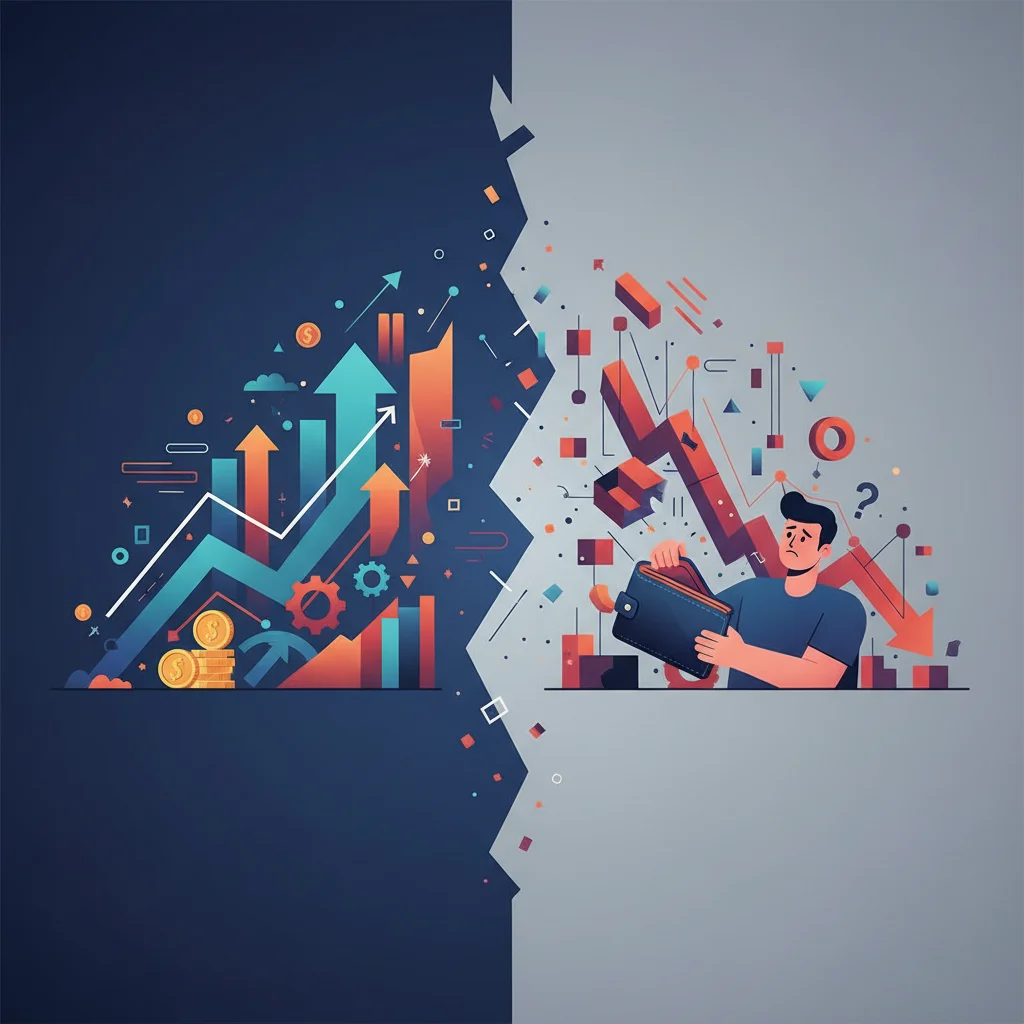
In the world of finance and investing, data is king. We build models, analyze trends, and make critical decisions based on metrics like GDP growth, unemployment rates, and inflation figures. By most traditional measures, the US economy is performing remarkably well. Yet, a walk down Main Street or a scroll through social media tells a completely different story—one of anxiety, frustration, and a pervasive sense that things are broken. This jarring disconnect between hard data and public sentiment has a name: the “vibecession.”
This phenomenon was the central topic of a recent, weighty discussion between two titans of economics, Martin Wolf of the Financial Times and Nobel laureate Paul Krugman. Their exchange wasn’t just an academic exercise; it was a stark warning about how this gap between perception and reality is creating profound risks for the stock market, global stability, and the very foundations of American democracy. They argue that we are no longer just debating economic policy, but confronting a crisis where negative “vibes” could potentially upend the global order.
In this analysis, we will delve into the heart of the Wolf-Krugman exchange, dissecting the data behind the strong economy, exploring the psychological roots of the “vibecession,” and spelling out the critical implications for investors, business leaders, and the future of our financial systems.
The Economy on Paper: A Picture of Robust Health
Before we explore the pervasive gloom, it’s essential to understand why economists like Krugman are, as he puts it, “objectively, in a better place” than they were a year ago. The data paints a picture of a resilient and surprisingly strong US economy that has defied predictions of a recession following the post-pandemic inflation spike.
Let’s look at the key indicators that underpin this optimistic view:
| Economic Indicator | Current Status & Significance |
|---|---|
| Unemployment Rate | Remains at historically low levels, indicating a tight labor market where jobs are plentiful. This typically translates to wage growth and strong consumer spending power. |
| GDP Growth | The US has consistently posted strong GDP growth figures, outpacing most other advanced economies and showing resilience in the face of higher interest rates. |
| Inflation | After peaking, inflation has been steadily declining towards the Federal Reserve’s 2% target without triggering the painful recession many feared—a so-called “soft landing.” (source) |
| Wage Growth | For many workers, particularly those in lower-income brackets, wage growth has outpaced inflation, meaning their real purchasing power is increasing. |
From a purely economic standpoint, this is the kind of performance that should inspire confidence. A strong labor market, robust growth, and tamed inflation are the textbook ingredients for prosperity. So why does a significant portion of the population feel left behind and pessimistic?
Decoding the ‘Vibecession’: When Feelings Trump Facts
The term “vibecession,” coined by Kyla Scanlon, perfectly captures the essence of the problem: a recession based on vibes and perception, not economic data. Wolf and Krugman identify several powerful forces fueling this national malaise.
First and foremost is the psychological scar of the recent inflation surge. Even though inflation is cooling, the sticker shock from a rapid 40-year high in prices for essentials like gas and groceries lingers. As Krugman notes, “people hate inflation.” The memory of that sharp financial pain is more potent and emotionally resonant than a government statistic showing that price growth is slowing.
Second, partisan media ecosystems play a significant role. In a hyper-polarized environment, perceptions of the economy are heavily filtered through a political lens. News and social media outlets often amplify negative stories that confirm pre-existing biases, creating feedback loops of pessimism. For a large segment of the population, their belief about the economy is shaped more by their political identity than by their personal financial situation.
Finally, while the macroeconomic picture is bright, individual circumstances vary. The high interest rates engineered by the Fed to fight inflation have made major life purchases, like homes and cars, prohibitively expensive for many. The dream of homeownership feels more distant than ever for younger generations, creating a legitimate source of economic anxiety that aggregate GDP figures don’t capture.
The Ultimate Risk: When Economic Discontent Threatens Democracy
The core of the Wolf-Krugman discussion is not just about economics; it’s about the catastrophic political consequences that could arise from the “vibecession.” Their greatest fear is that this widespread negative sentiment, however disconnected from reality, will pave the way for a second Donald Trump presidency, which they view as an existential threat to American democracy and the global economic order.
They argue that the danger lies in a potential administration that actively undermines the very institutions that ensure market stability and the rule of law. Krugman expresses “apocalyptic fears” about this outcome, a sentiment Wolf shares, calling it a “nightmare.” Their concerns are not abstract; they focus on specific, tangible threats:
- Erosion of Institutional Independence: A key pillar of a stable economy is an independent central bank. Threats to the Federal Reserve’s autonomy could lead to politically motivated monetary policy, runaway inflation, and a catastrophic loss of confidence in the US dollar. This would send shockwaves through the global banking system.
- Aggressive Protectionism: The imposition of sweeping tariffs, as has been proposed, would likely ignite global trade wars. This would disrupt supply chains, increase consumer costs, and hammer the profitability of multinational corporations that form the backbone of the stock market.
- Disregard for the Rule of Law: For investors, the rule of law is paramount. It guarantees that contracts are enforced, property rights are protected, and regulations are predictable. An administration that selectively enforces laws or uses state power to punish political opponents creates a level of uncertainty that is poison to capital investment and long-term planning.
Wolf grimly concludes that a failure to preserve liberal democracy in the US would be a “disaster of colossal proportions” for the world. The stability that has underpinned the global financial system since World War II—built on American institutions, alliances, and the dollar—would be thrown into question.
Cracks in the Golden Empire: Is Mining Giant Barrick Gold on the Brink of a Break-Up?
Actionable Insights for Investors and Business Leaders
This high-stakes discussion is not merely a political debate; it provides a critical framework for risk management in today’s volatile environment. The “vibecession” and its political fallout must now be a core consideration in any serious financial strategy.
For Investors: Political risk is no longer a tail risk; it is a central one. Portfolios must be stress-tested for scenarios that were once considered unthinkable. This means:
- Geographic Diversification: Reducing over-concentration in US assets and considering markets with different political and economic drivers.
- Sector-Specific Analysis: Understanding which industries (e.g., global trade, renewable energy) are most vulnerable to drastic policy shifts versus those that might be more resilient (e.g., domestic consumer staples).
- Valuing Stability: Placing a premium on companies and markets that operate under stable, predictable legal and regulatory regimes.
For Business Leaders: The era of stable, predictable globalization may be ending. Strategic planning must now account for radical uncertainty. This involves building more resilient supply chains, hedging against currency volatility, and developing contingency plans for rapid changes in trade and regulatory policy. The ability to pivot quickly will be a key determinant of survival and success.
For the Finance Industry: The entire ecosystem, from traditional banking to cutting-edge fintech and even decentralized systems like blockchain, relies on a foundation of legal and institutional trust. A crisis in the rule of law is a systemic risk that threatens the entire apparatus. Financial institutions must bolster their risk models to account for previously unimaginable political scenarios in the world’s largest economy.
Beyond the Headlines: The Economic Shockwaves of West Bank Instability for Investors
Conclusion: A Battle for Reality
The conversation between Martin Wolf and Paul Krugman serves as a powerful wake-up call. The great disconnect between economic data and public perception is more than a curiosity—it has become a potent political force with the power to reshape the world. The “vibecession” demonstrates that in today’s information environment, narrative can be more powerful than numbers, and sentiment can override fundamentals.
For those of us in the world of finance, economics, and investing, this presents a profound challenge. We must learn to navigate a landscape where political risk is paramount and where the very stability of the institutions we take for granted is in question. The stakes, as Wolf and Krugman make clear, extend far beyond our portfolios. They concern the future of a stable, predictable, and prosperous global order.